



Have you ever questioned yourself about the functioning of such a cryptocurrency as Bitcoin or Ethereum? Who verifies that your business deal is genuine? Who mints new coins to the system? And who checks nobody cheating?
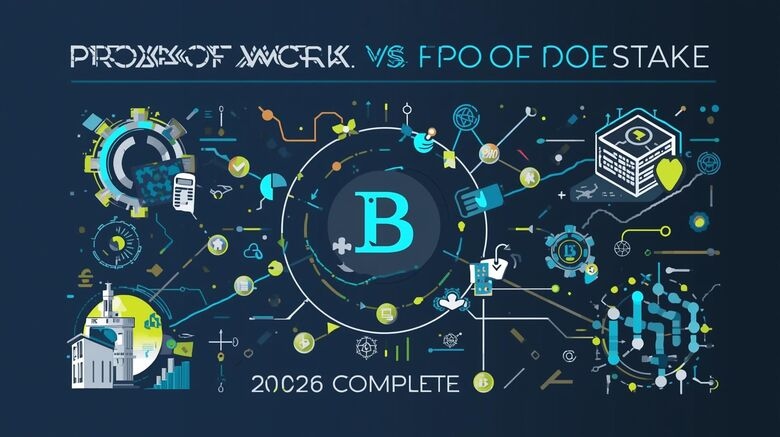
The solution is the consensus mechanism and the two most popular in the entire crypto world are Proof of Work (PoW) and Proof of Stake (PoS). These are the two motors of nearly all major blockchains on the planet.
We shall in this comprehensive manual relate the two mechanisms in plain, easy to understand English. No complex language, no mathy stuff. No bells or whistles, no imaginary illustrations, and a plain answer to what is better and why it should be of interest to you as an investor.
What is Consensus Mechanism?
We should first determine what a consensus mechanism is before we make a comparison between PoW and PoS since this is the basis of it all.A blockchain is essentially a digital record book that is replicated on thousands of computers across the globe. It is not controlled by any specific company or government. So here is the large question; how can everyone come to an agreement on what is true?
Suppose Alice sends 1 Bitcoin to Bob, how is it that all the computers of the network are able to agree that the transaction in question did actually occur and is valid? This is the very issue that a consensus mechanism will address.
A consensus mechanism is a framework of rules that every computer in a blockchain network adheres to in reaching a consensus on the transactions that are legitimate and the new block that can be added to the chain. In the absence of it, blockchain would degenerate into anarchy where anyone could forge transactions and loot money.
Basic Terms A consensus mechanism can be defined as a voting mechanism in a blockchain. It is the way thousands of computers come to agreement without there being trust amongst one another.
What is Proof of Work (PoW)?
The first consensus is Proof of Work. It was invented by the enigmatic founder of Bitcoin Satoshi Nakamoto and presented to the world with the Bitcoin in 2009. It is the grand-papa of blockchain technology.
The concept is straightforward at a basic level: to make a new block of transactions to the blockchain, a computer should be capable of demonstrating that it has performed a significant amount of computational work. That is working out a very difficult mathematical problem.
The Graphical Process of Proof of Work:
1st step involves the grouping of transactions
Whenever individuals send and receive Bitcoin, they are assembled and joined together in a block. This block is ready to be linked to the blockchain but it must first be checked.
Step 2: Miners Race to Find a Solution to a Puzzle
Computers do the work and these are known as miners. Competition to solve a mathematical puzzle that is complex and is referred to as a hash function involves thousands of miners across the world. This maze takes tremendous computer capacity to break but very simple to ensure that all others confirm that one has the correct answer.
Imagine it in this way: finding the solution of the puzzle is an issue of finding a needle in a billion haystacks. But when you have it you can know in a second that you have the right needle.
Step 3: The Winner Takes the Reward.
The miner, who cracks the puzzle first, is the winner. They receive a block reward for new Bitcoin and are allowed to append the next block into the blockchain in addition to all the transaction fees in that block. By 2026, the block reward of Bitcoin will be 3.125 BTC (following a 2024 reduction by half).
Step 4: The Process Repeats
The competition is then repeated with the addition of a block. A Bitcoin block is added after every 10 minutes or so. This has been going on since January 2009.
Live Case Study: Bitcoin is a Proof of Work. At its height, the Bitcoin mining system consumed more power than the complete Argentina country. That is the work in Proof of Work huge, real-world energy consumption.
What is Proof of Stake (PoS)?
Proof of Stake is a more recent consensus mechanism, which was first introduced by Peercoin in 2012 and popularized when Ethereum transitioned to PoS in September 2022 a phenomenon known as The Merge.
Proof of Stake relies on economic value instead of the computing power and electricity, which are used to secure the network. Members pledge (or stash) some amount of cryptocurrency as security. They are then chosen randomly in order to authenticate transactions and append new blocks.
The point is the following: when you have much money invested into the network, you have a good financial incentive to act honestly. You lose your bet in case you cheat. This is called slashing.
Stepwise process of Proof of Stake:
Step 1: Staking Coins by the Validators
Participants do not purchase mining hardware but rather lock away some quantity of cryptocurrency in a specific smart contract. This is their stake, which is stuck up. In Ethereum, the required minimum amount to be a validator is 32 ETH. Other blockchains have cheaper requirements.
Step 2: A Validator is Selected
The network picks a validator to propose the successive block randomly. There is no totally random validation of selectors with more stake having a higher probability of being chosen. It resembles a lottery, the more tickets one buys the better chance he gets.
Step 3: Other Checkers Authenticate
When a validator proposes a block it is checked by a group of other validators. When a majority of the consensus is that it is valid, the block is appended to the blockchain. The process occurs significantly quicker than the mining competition in PoW.
Step 4: Rewards are given out
The validator and the confirming committee are all entitled to a share in the transaction fees and coins that are created every time. The higher the stakes, the higher the returns in the long run.
Actual Case: In 2022, Ethereum transitioned to PoS and instantly cut their energy usage by 99.95. It currently requires approximately 20 minutes of Netflix to process a transaction in Ethereum.
Full P2P vs Proof of Stake vs Proof of Work: Full Comparison
And here is the full side-by-side comparison between the two consensus mechanisms to enable you to see all the differences at a glance:
| Feature | Proof of Work (PoW) | Proof of Stake (PoS) |
| Created By | Satoshi Nakamoto (2009) | Scott Nadal & Sunny King (2012) |
| How It Works | Miners solve math puzzles | Validators stake coins |
| Energy Use | Very High (like a small country) | 99% less energy than PoW |
| Hardware Needed | Expensive mining rigs (ASICs) | Regular computer / no special hardware |
| Security Model | 51% computing power attack | 51% coin ownership attack |
| Transaction Speed | Slow (~7 TPS for Bitcoin) | Fast (1,000–100,000+ TPS) |
| Decentralization | High — anyone can mine | Growing — validators required |
| Main Users | Bitcoin, Litecoin, Monero | Ethereum, Cardano, Solana |
| Rewards | Block reward + transaction fees | Staking rewards + transaction fees |
| Best For | Maximum security & decentralization | Speed, efficiency & scalability |
Proof of Work: Pros and Cons
Pros of Proof of Work:
- Battle-Tested Security: The bitcoin has been operating on PoW since 2009 and has survived 15 years to date without any successful attack on the consensus mechanism. This is a history that cannot be matched in the crypto industry.
- True Decentralization: PoW mining can technically occur at any place as long as one has a computer. This complicates the situation of having any one group seizing the network.
- Time Tested: PoW model is the most common type of Bitcoin known to governments, institutions, and regulators. It is the most widely known and embraced consensus of blockchain in the world.
- Fair Initial Distribution: PoW provides new coins as a reward of actual work. This is perceived as a more equal method of apportioning coins compared to PoS whereby early possessors would have a greater opportunity to gain more money simply because they had more money.
- Immutable History: This makes it astronomically expensive to write or modify the blockchain of Bitcoins and thus the transactions that occurred in the past are practically unalterable or falsifiable.
Cons of Proof of Work:
- Energy-intensive Process: Bitcoin mining consumes more energy than certain countries. This is becoming a major issue to PoW adoption as climate issues continue to increase.
- High Mining Costs: Competitive mining involves the use of specialized machines known as ASICs that are thousands of dollars. This excludes the commoners and concentrates the mining resources in few large corporations.
- Lack of a Fast Transaction Speed: Bitcoin is relatively slow with 7 transactions per second (TPS). In comparison, Visa manages 24, 000 TPS. This renders PoW impractical to daily scale payments.
- Mining Centralization: As a matter of fact, large mining farms in low-cost electricity countries perform most of the Bitcoin mining. This is contrary to the ideal of decentralization.
- E-Waste Issue: Old mining equipment covers out of fashion at a very fast rate and leaves a huge electronic waste in the environment, another environmental issue.
Proof of Stake: Pros and Cons
Pros of Proof of Stake:
- Very energy-efficient: PoS consumes a maximum of 99.95% of the energy consumed by PoW. This renders it much more sustainable to the environment and long-term.
- High Throughput of Transactions: PoS blockchains are much faster at processing transactions because there are no energy-intensive mining competitions. An example is Solana which manages more than 65, 000 TPS.
- Reduced Barrier to Entry: You do not require costly hardware to get into it. Any person can place bets on coins and get reward with the help of a normal computer or even with the help of a staking service.
- Passive Income: Staking your crypto in a PoS network makes you receive regular rewards which resemble earning interest in a savings account. Ether staking is presently paying approximately 3-5 percent per annum.
- Scalability: PoS has a higher performance in terms of high-volume applications, such as DeFi, NFTs, and Web3 due to its ability to execute significantly more transactions per second.
Cons of Proof of Stake:
- The Risk of Wealth Concentration: In PoS, those who possess higher coins own more power. The opponents state that this is a kind of a rich get richer situation because big holders always get more rewards and power.
- Weaker Reputation: PoS is not as old as PoW. Although it has been successful thus far, the Proof of Work is battle-tested to a greater extent than Bitcoin.
- Staking Lock-Up Periods: In staking your coins, they are usually locked out at some specific time. In case of a crash in the market, you are not able to sell your staked coins immediately and this may cause losses.
- Reducing Risk: Slasher Slasher It is possible that validators can be slashed (have their staked coins destroyed) because they act dishonest or they go offline during an inappropriate moment. This is one of the real financial risks to validators.
- Nothing-at-Stake Problem: The initial PoS design was theoretically susceptible to a man in the middle attack in which validators would vote on several conflicting blocks, and be allowed to do so, without cost. This is greatly addressed by modern PoS systems although it still is a discussion point.
Live Blockchains: PoW vs PoS
To see how the two mechanisms work on actual blockchain networks, we will consider the following:
| Blockchain | Consensus | Speed (TPS) | Energy Use | Market Rank |
| Bitcoin | PoW | ~7 | Very High | #1 |
| Litecoin | PoW | ~56 | High | Top 20 |
| Ethereum | PoS | ~30 | Very Low | #2 |
| Cardano | PoS | ~250 | Very Low | Top 10 |
| Solana | PoS (hybrid) | ~65,000 | Extremely Low | Top 5 |
Security: Which Consensus Mechanism is Safer?
The most critical aspect in the evaluation of a blockchain is security. Both PoW and PoS are secure though they encounter various threats.
The 51% Attack Explained:
PoW and PoS are both susceptible to a so-called 51 percent attack. This is the point at which one individual is able to control over half of the network power either computing power (PoW) or staked coins (PoS); In case this occurs, the attacker would be capable of doubling coins or halting subsequent transactions being approved. The price of doing this is however staggering on large networks.
51% Attack Cost on PoW (Bitcoin):
The PoW network of Bitcoin is designed to make it extremely difficult to attack by controlling over half of all the mining equipment in the globe. By 2026, billions of dollars in equipment and electricity would be required to do that and the attack would probably be stopped before it could occur.
51% Attack Cost on PoS (Ethereum):
To breach the PoS network of Ethereum, one would have to possess over 51 percent of staked ETH. Billions of dollars of ETH, that is in 2026. And had you attempted to attack, you would have your own coins cut meaning that you would be cutting your own throat in the process of making the investment.
Security Verdict: The longest and most established security record is experienced by the PoW in Bitcoin. Ether security is also very secure with slashing added protection of PoS. Both are said to be very safe at their present network size.
Big Debate: Environmental Impact
Energy is one of the largest debates in the crypto world that is still ongoing. Opponents of Bitcoin believe that PoW mining is an ecological catastrophe. Proponents claim that the security and decentralization is worth the energy usage.
The Anti-PoW Arguments:
- Energy Equal to Countries: At full capacity, Bitcoin mining used more power in a year than other countries such as Argentina, Poland and Norway.
- Carbon footprint: A good part of the mining electricity is produced through fossil fuels which add to carbon emission and climatic change.
- E-Waste: Mining hardware wastes fast thus generating a lot of electronic waste every year.
The Pro-PoW Counter-Arguments:
- Renewable Energy Usage: It is becoming increasingly apparent that a larger percentage of Bitcoin mining has to be minimized to at least 50 percent in 2026 based on renewable energy sources of solar, wind, and hydropower.
- Energy Monetization: Bitcoin mining has the potential to utilize stranded energy (energy that could otherwise be wasted) and contribute towards the growth of renewable energy infrastructure.
- Security Has a Price: The proponents believe that securing a global financial system by using energy is a normal and even effective way of using electricity.
Environmental Verdict The obvious winner here is Environmental Proof of Stake. By transitioning to PoS in 2022, Ethereum saved its carbon footprint by more than 99.95. PoS blockchains are more environmentally friendly and thus are the obvious choice of environmentally conscious investors.
PoW or PoS: Which is the best Investing Choice?
And if you are an investor not a miner, or a validator, you are likely asking yourself: What kind of blockchain should I invest in? Here is a clear breakdown.
- Supply chain: Invest in Proof of Work (Bitcoin):
- Digital Gold Narrative: Bitcoin is being more and more compared to gold as a store of value. Bitcoin is also kept by many institutional investors as an inflation and currency devaluation hedging.
- Scarcity in Supply: There is a fixed amount of Bitcoin to 21 million coins. This is coupled with the fact that mining is expensive hence the economic building blocks of Bitcoin are robust.
- Institutional Adoption: In 2024, the US passed Bitcoin Spot ETFs – a massive move that introduced billions of dollars of conventional investors to Bitcoin.
- Less Risky Profile: Bitcoin is the most developed cryptocurrency. It has the longest history of operation (15 years), thus making it the least risky crypto investment to the conservative investor.
Investment in the Proof of Stake (Etherium, Solana, Cardano):
- Staking Income: PoS coins will allow you to receive passive income through staking. Presently Ethereum has a range of 3-5% APY, and there are others with smaller PoS chains that have higher returns.
- Utility and Growth: DeFi, NFTs, smart contracts, and Web3 are PoS blockchains with enormous growth opportunities.
- Lower Energy Narrative: PoS coins are better than ESG as the green crypto-coin as ESG is becoming more popular.
- More risk, More potential: PoS altcoins such as Solana and Cardano are riskier than Bitcoin, but associated with higher potential gains to investors who can afford to take volatility risks.
Investment Tip: Most intelligent investors have BOTH. Bitcoin (PoW) as a long-term and stable store of value and Ethereum or Solana (PoS) as growth, staking income and exposure to Web3 and DeFi. There is nothing wiser than diversification.
What is Better: Proof of Work or Proof of Stake?
And here is the plain truth, neither is always better. Both of them have a purpose and each is good in various aspects. It will be all on what matters the most to you.
Select Proof of Work when you value:
- Maximum security and a track record of 15 years.
- Veritable decentralization not based on the rich.
- Hoard something as hard and scarce as digital gold.
- Trading Bitcoin as a long-term investment.
Select Proof of Stake when you put much value on:
- Energy conservation and a reduced environmental footprint.
- Quicker and reduced charges in day to day usage.
- Stake rewards to earn passive income.
- Being engaged in DeFi, NFTs, smart contracts, and Web3.
- Scalability capacity to reach out to millions of users and transactions.
The fact of matter is that both systems will coexist in 2026 and fulfill various functions in the crypto ecosystem. The gold standard of security and trust is the PoW of Bitcoin. The PoS by Ethereum is the driver of the future internet.
The Future: What Is the Future of These Technologies?
The blockchain world is a constantly developing sphere. This is what is occurring in both consensus mechanisms in 2026 or later.
The Future of Proof of Work:
- Bitcoin Halving Effect: The 2024 halving saw the block reward of Bitcoin decrease to 3.125BTC. The subsequent halvings will keep on decreasing supply, which in the past brought about price increases.
- Green Mining Push: An increasing number of mining activities are moving towards the use of 100% renewable energy. El Salvador is one of the countries that utilize volcanic geothermal energy to mine Bitcoin.
- Layer 2 Solutions: A solution such as the Lightning Network is an application constructed over Bitcoin to provide fast and low-cost transactions that address the speed issue of PoW by modifying the base layer.
The Future of Proof of Stake:
- Ethereum Upgrades: Ethereum keeps upgrading their PoS system making the transactions faster and reducing the fees and enhancing security of the validators.
- New PoS Blockchains: New blockchains such as Sui, Aptos, and Sei are being launched with new PoS variants that are more affordable and faster in nature.
- Liquid Staking: Liquid staking such as Lido enables users to stake and retain a coin to use in DeFi and solve the lock-up problem as well as make staking more accessible.
- Prospects: PoW and PoS are likely to coexist over a long period of time. The PoW of Bitcoin will keep being the backbone of digital gold. The applications and financial infrastructure of the decentralized internet will be powered by POS.
Conclusion
Proof of Work and Proof of Stake are extremely different answers to the same question: how can you have thousands of computers in the world agree on the truth, and not trust each other?
PoW addresses this by energy and computing power producing something as substantial and enduring as cut stone. This is solved by PoS using economic incentives and financial collateral to make something faster, cheaper and greener.
Neither one is perfect. PoW is sluggish and power-intensive but hardened in battle and venerated by the biggest organizations in the world. PoS is quick and effective but more modern and yet to be tested in various market situations.
Being a crypto fan or investor, being acquainted with both mechanisms will place you at a huge advantage. What you are putting your money into and why you are taking what sort of risks you are taking and why each blockchain is making the decisions it does.
The best approach? Do not pick sides. Study both. Invest in what is in line with what you aim to. And it is always the most essential rule in crypto; always do your own research (DYOR) and never invest more than you can lose.